There are three phases for a common faint. Phase one is the buildup to the faint, called prodrome, which can include symptoms such as epigastric discomfort, dizziness, or weakness. In the Frida Kahlo exhibit at the Brooklyn Museum in 2019, I felt these effects as my heart dropped into my stomach, a blurry fuzz filled in for my fading vision, and my head heavied in preparation for a drop. Mostly, though, I felt irrationally angry. The crowded rooms full of slow-walking art observers excited my irritation, their faces became strangely unnerving and moving from room to room felt never-ending. Prodrome can last anywhere from a few seconds to many minutes before a sharp transition into phase two of the common faint. I withstood a couple minutes within the white walls, dashed vibrantly with fabrics and paintings, before I pulled my family away and we flew all the way to the museum café, where a stomach of granola bars and guilt supplanted my filling feeling of nothingness. I practically missed the museum exhibit, but I suppressed my first experience with prodrome before my body shut off– a fate I had trouble replicating for the next year.
Phase two of the common faint: a loss of consciousness. Momentary bodily defeat. An unconscious pain. When Frida Kahlo was eighteen, the prodrome to her fall was clear-headed and unwary. She rode on a bus for only a few minutes before it slammed into a trolley car, driving a metal rod through her midsection and permanently damaging her bone structure. Kahlo, who later described the crash as “dull and slow,” would have experienced the symptoms of the build-up during the moments between the impact to the vehicle and the impact to the body. Then, a fade to black, and an irrevocable injury. If I had paid any attention at the Brooklyn Museum, I would have seen that the Frida Kahlo exhibit was entitled “Appearances Can Be Deceiving.” There was nothing deceiving in the appearance of Kahlo’s accident. It was an unmistakable tragedy.
In July of 2020, a year after my freak-out in the museum, I ended my day how a fifteen-year-old in house lockdown could be expected to– playing video games until the late hours of the night. When I finally stood up to walk to bed, I felt my head thicken and my eyes dampen. As the swirling symptoms of prodrome blanched me, I proceeded as normal hoping my body would fix itself. I slowly made my way to the wall, reached over for the light switch, then blacked out as my body dropped. The second stage of the faint– an unexperienced fall. Like Frida Kahlo, I had limited time to prepare for or understand what was about to happen, and then I was met with pain. The cut under my right arm and tear in my sweatpants left proportionally miniscule damage to that of Kahlo’s situation, but they were equally unexpected. I awkwardly sat on the hardwood floor of my own home at four in the morning with a dizzy head and cuts on my side before I stood back up, texted my parents to let them know that I had fainted, drank a glass of water, and went to bed.
After my first experience with an unprepared fall, I stumbled through the course of first-time pains: the loneliness of a pandemic-ridden Philadelphia, working a miserable job at a summer camp with suspiciously low pay, coping with the sudden end to my first serious relationship, having to see a therapist for the first time. I fainted semi-regularly, and it felt like I had lost my equilibrium. In emotional explosions and quiet recoveries, the process of fainting patterned itself over my early high school existence. Reflecting back to this time, I am reminded of a quote my dad shared with me from Nick Cave, a musician and frontman for a popular band. Cave once wrote in response to a fan who was struggling to deal with reminders of their ex-girlfriend in the artist’s music, “we heal by acknowledging our emotions and test our heart’s resistance by lingering within the unbearable.” Breakups, like my 4:00 a.m. faint, can be sudden, painful, and confusing. My dad and Cave’s advice is to grow by working through the pain, not around it or in spite of it. Absorbing the hurt reflects its worth, and the resilience to grow through it proves the damage to be non-defining. After fainting, I could not stand back up and pretend to feel the same as I did sitting in front of my television only a minute before.
Phase three of the common faint, named post-syncopal, drastically varies in length, leaving the effects of disorientation and a feeling of poor health. After her bus incident, Frida Kahlo found herself nearly immobile with all of her broken bones. She had to wear a plaster corset in order to keep her spine medically intact and able to support her body, which could only be removed by surgical pliers. The artist wrote in a letter to her boyfriend of the time that she lived “in a painful planet, transparent as ice.” Kahlo’s post-syncopal was a dramatic shift in her life, her identity. Goals of becoming a doctor became obsolete, inhibited by a chronic pain that would stay through the rest of her days. But as the pain continued, Kahlo’s artistry was able to take over. The difficulty of her post-syncopal immobility allowed for the time and capability to paint, and many of her pieces were made to represent her physical difficulties. Additionally, Kahlo wove traditional Mexican dresses, long enough to conceal her corset and limp. By lingering in the unbearableness of her painful planet, Frida Kahlo was able to create an incredible amount of beauty. She grew as a person and an artist through her pain, finding opportunity in the disorientation of the aftermath. The Brooklyn Museum sought to put Kahlo’s disability-related artwork on display, including her vibrant dresses, self-portraits, and even the front half of one of her corsets colorfully painted over. The titular piece of the exhibition is a sketch of Kahlo wearing a purple dress, which is drawn transparently to reveal her body underneath, covered only by a red plaster corset. Under the drawing Kahlo’s own words are written out: “las apariencias engañar” or “appearances can be deceiving.”
The art collection’s lesson of finding purpose through pain was lost on me at the time of my visit, but I was only in the prodrome of experiential pain, both literally as I neared a faint, and in the course of life itself, as I was yet to fall into loss in any recognizable way. I did not understand the importance of Kahlo’s message until the last time I fainted, only a year after the first. In the summer of 2021, I was in an Apple store with a friend, leaning on a table in exhausted patience for an iPad to be fixed, until my body could not support itself anymore and I fell. I became nothing for a few fleeting moments, and then I returned to self in a fallen state, filled with regret for allowing the whole event to even occur. This time, I found myself unable to stand back up.
In Shakespeare’s tragedy King Lear, Edgar falls victim to a plot against him, forcing him to abandon his entire identity and live without accommodation. Completely reduced, Edgar is able to bravely claim that “to be worst, / The lowest and most dejected thing of Fortune, / Stands still in esperance, lives not in fear.” Edgar is solidified in an esperance, or hope, that he could not possess without being completely reduced, and so he has found something in nothing. There is so much pain in the fall, and there is so much hope in being fallen. In the Apple store, my post-syncopal phase consisted of a mall cop, a wheelchair, a frightened friend’s mother, and a load of embarrassment as the color returned to my cheeks. At a similar time that I sought help through the painful feelings that came after my first serious relationship ended, I also worked through the painful feelings of my fainting. Instead of avoiding the issue, I became conscious of my hydration, not buckling my knees, and sitting down when the fuzzy sensation began to build in my body. For Edgar, his post-fall stage is a realization of his fallen potential. It is not by coincidence that Edgar is one of the few characters to survive Shakespeare’s tragedy.
The Brooklyn Museum highlighted Frida Kahlo’s creation through her disability because she did not exist without a weakened spine and a shattered leg– they were a part of her being, an essential aspect of herself and, therefore, her creations. However, when looking at one of the large, gorgeous dresses sewn by Kahlo, the art is able to appeal even without knowledge that it was made this way to hide a limp. In a similar sense, every time I fainted, I was made to linger in the symptomatic feeling of poor health, and so my pale-white face has become equally a part of me as my rosy cheeks. Looking at myself now, it would be impossible to know that I fainted regularly only a few years ago, but one state of being does not exist without the other. When the heart proves itself resilient, appearances can become wonderfully deceiving.
The three phases of a common faint are medically known as the prodrome, loss of consciousness, and post-syncopal. In other words, I feel, I faint, and then I stand back up again; anger, pain, and then esperance. Limps and shattered bones lie underneath painted plaster corsets and ruffled draping dresses. My heart will drop to my stomach, and I will linger in the unbearable, and I will do so with hope.
Henry Chiles is a current undergraduate student majoring in English.
Chiles says about the piece: “I was inspired by my family, Shakespeare, and “Man’s Search for Meaning” by Viktor Frankl.”
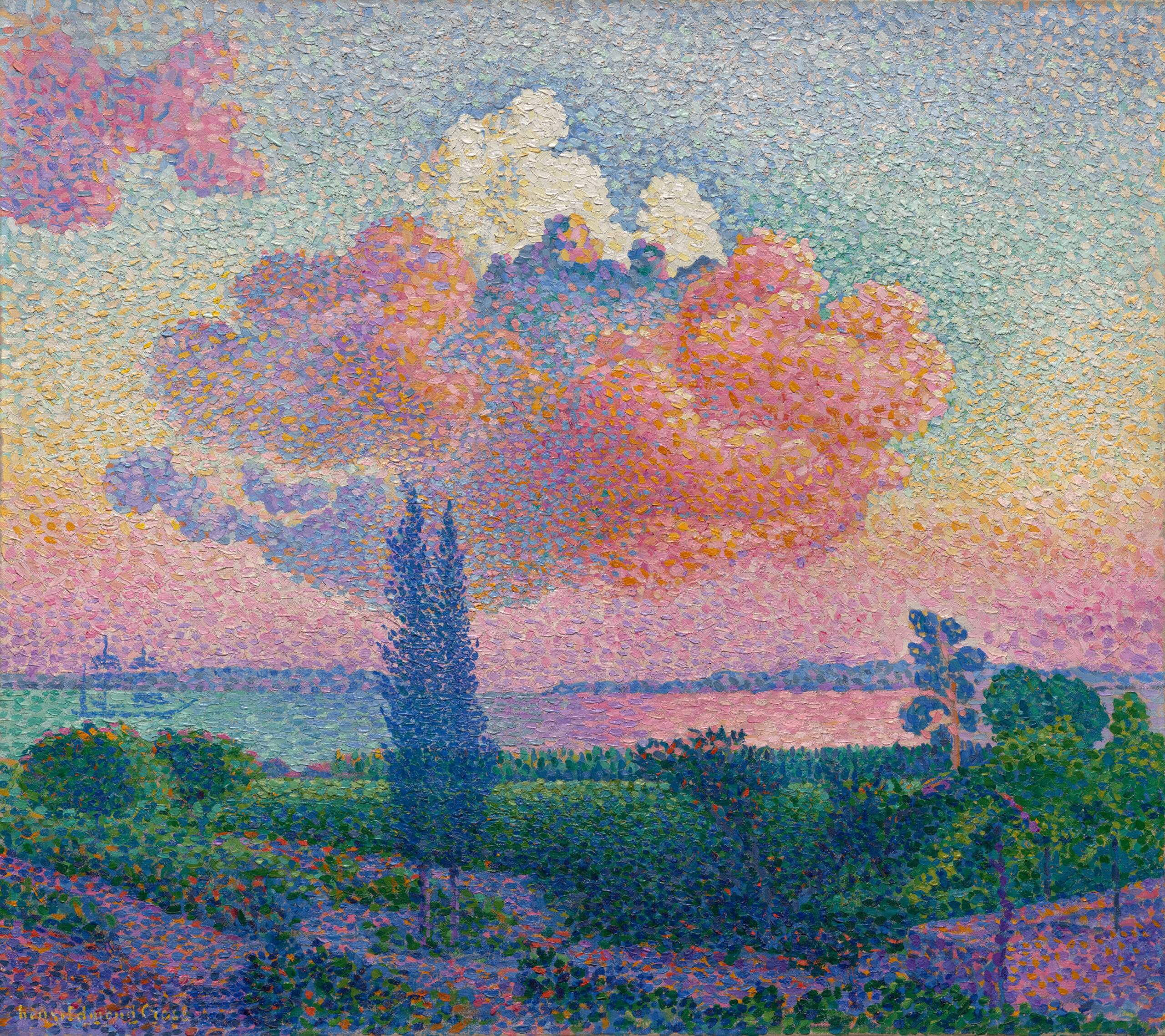
“The Pink Cloud”, Henri-Edmond Cross (1896).